
Book Review: Jordan Peterson, We Who Wrestle with God (2024)
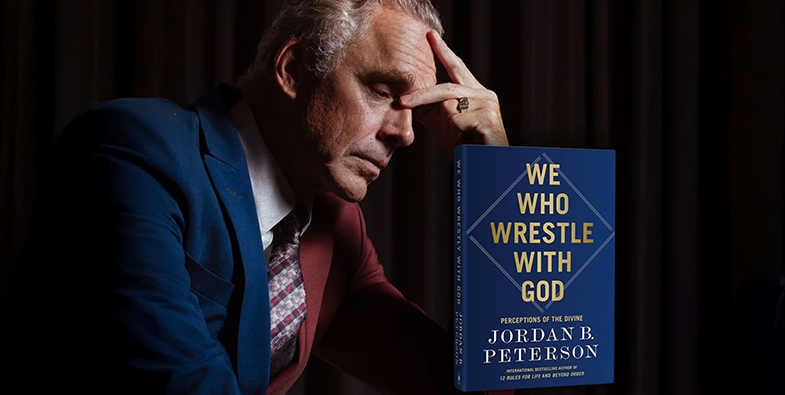
Overview and Background of Jordan Peterson
We Who Wrestle with God by Jordan Peterson provides an exposition of the first five books of the Bible along with the book of Jonah. In the book, he argues that stories help people prioritize decision-making, and he retells the stories while elucidating significance and meaning. By doing so, he urges readers to wrestle with God in pursuing a higher calling to live a moral and meaningful life.
Jordan Peterson is a world-renown clinical psychologist, best-selling author, and Internet sensation. He received his bachelor’s degree in political science and psychology at the University of Alberta and a PhD in clinical psychology at McGill University. He served as a professor at Harvard University and then the University of Toronto. After publicly criticizing Canadian Bill C-16 on gender identity in 2016, he has since become involved in political discussions and has gained popularity and disdain for his public statements in favor of classical liberalism, individualism, and traditionalism on social media, mainstream news, and debates. He was a practicing psychologist seeing about 20 patients a week until 2018. He retired from the University of Toronto in 2021 and became chancellor of Ralston College in 2022. He is currently secluded due to health issues.
Published in 2024, We Who Wrestle with God places Peterson squarely in the theist column, despite previous claims to atheism or agnosticism. While he has frequently refused to be labeled, even going so far as denying he was arguing from a Christian perspective in a 2025 debate with 20 atheists, he has since confessed to be a Christian, though he often distances himself from Christian doctrine and claims. It is difficult to surmise exactly what he believes due to his frequent evasion, whether this is out of concern of losing followers, intellectual honesty, or his own privacy. Nevertheless, it’s clear that like many intellectuals he wants to believe but struggles with the historical nature of Christian claims. As with his 1999 book Maps of Meaning, readers should see the book not as a theological book but as a study of the psychology of religion and the need for faith to find meaning in life in order to guide people to a better existence.
Biblical Interpretation, Themes, and Narrative Analysis
Peterson begins by retelling the story of Elijah hearing the “still small voice” of God while hiding from the wrath of Jezebel in a cave (1 Kings 19:12). He argues that God’s voice is primarily within us as our conscience and not in nature or history. “This can well be considered a more powerful and justified argument than the now much more frequently used ‘argument from design.’” In other words, his apologetic approach is the argument from morality or the belief that God can best be known through right and wrong rather than fact. He downplays the importance of a historical creation or biblical books in favor of faith.
The challenge with following the still small voice is that people struggle with more data than they can process, which leads to prioritization. Jordan argues stories help us prioritize what’s important by instilling meaning that overrides the complexity of modern life. In his view, whether people take the Bible as factual or not, the stories can help people in this struggle with the voice of God within and recognize themselves as connected to the Logos or Word, which constantly speaks to us.
Over the next 400-odd pages, Peterson goes on to discuss the ethical meaning of creation, the Fall, Cain and Abel, Noah, the Tower of Babel, Abraham, Moses, and Jonah. Some observations are mundane and often-repeated tropes, such as presenting the Fall as the result of pride and rejection of the natural moral order, Cain and Abel as a fraternal feud, Abraham as an adventurer stepping out in faith and taking risks to travel to a new land, or Jonah as a prophet struggling with racism that made him repent his good deeds. In other places, his analysis is more complex, such as seeing the foreshadowing of Abel as the good shepherd, Abraham’s sacrifice of his son as the lamb of God, and the serpent in the wilderness as a sign used by Christ to explain His own role. In all cases, he weaves into his storytelling interesting side stories and explains the lessons to draw from them.
He summarizes the content of the book by noting that “the world is more than a mere collection of facts” and that there is no simple or direct path “from what is to what ought to be.” Each of the stories helps bridge this gap in unique ways, allowing us to share in the role of the eternal Logos and escape the hell of our existence. We do this by wrestling with God and aligning with eternal values. Only when we “reestablish our covenant” with the God of magical transformation can we “rescue the highest from its unconscious existence in the lowest.” We can only bring order to our chaotic and wicked lives through faith and a higher calling to truth and righteousness.
Reception, Historicity, and Theological Critique
Many have criticized the book as rambling, but it’s better described as conversational with a lot of rabbit holes and rhetorical flourishes that characterize Peterson’s public speaking. Because of his polarizing political views, critics either love or hate him, leading to overwhelming condemnation or praise. A more realistic appraisal of the book is that it presents a guide for those seeking an intellectual approach to the Bible to help them find faith and meaning without getting hung up on facts or semantics. This is especially useful for unbelievers or borderline believers struggling with life. It’s less useful for the believing Christian seeking for orthodox theological descriptions of the stories he retells. For Peterson, the Bible is a psychological tool to live a better life in faith, not a book of factual theological statements.
Perhaps the most important point along this line is Peterson’s overall rejection of the Bible as a historical, literal, and factual book. This is in keeping with the intellectual approach he has taken throughout his career and which is accepted by his peers. Faith is believing in something despite evidence against it rather than believing after being persuaded by evidence (which is the biblical definition). He has consistently refused to argue issues such as creation or the historicity of the biblical accounts, including the virgin birth, miracles or the resurrection. For him, these issues sidetrack people from spiritual truth, which is more important in leading us to faith and a more meaningful life. While he doesn’t directly deny the historical and physical realities of the Bible, he believes them less helpful in finding meaning.
The difficulty is that the truth of Christianity is based almost entirely on its historical claims. His arguments elsewhere that Christianity is not about facts are therefore either disingenuous or informed primarily by Gnosticism and liberal biblical criticism and theology rather than the gospel. Christianity is what C.S. Lewis called a true myth. What separates Christ from other mythical figures who return from death is that Jesus is a historical person who really did die and rise again and who lives forevermore. This fact is not only set out in the basic creed of Christianity – the Apostles Creed – it is also the basis for belief in atonement from sin and for a new life in Christ.
In a similar way, trying to glean morals from biblical stories while rejecting the factual foundation of the Bible often undermines trust in the stories themselves. If the stories in the Bible are nothing more than fiction, many will find nonbiblical fiction much more enthralling. What makes the Bible exciting is the possibility that it is true and that the creator of the universe entered history to save people who could not save themselves. Christ came not merely figuratively, but in fact. If Christ only saves us figuratively, He is of no use to us. While one can certainly have faith in God without believing in the historicity of the Bible, the end is usually a vague spirituality without defined creeds or doctrines focused primarily on self-improvement. Christianity teaches that we cannot save or even improve ourselves but must take on His life instead of our own. The historical Christ saves us and not merely belief in a vague God or living a good life.
Despite downplaying issues of biblical historicity, Peterson’s book, and his approach in general, remains helpful to those who are on the edge of faith. For the struggling intellectual not yet ready to give up liberal theology and the popular belief that the Bible is ahistorical, treating biblical stories as merely expertly crafted literary inventions can still lead to faith and a changed life. Belief in the Bible as the literal word of God can follow later. The first step is, as Peterson concludes his book, “to return to our origin, and to know the place, as conscious adults, for the first time. God is dead? No. Deus Renatus Est [God is reborn].”
