
Can God Speak Through AI?
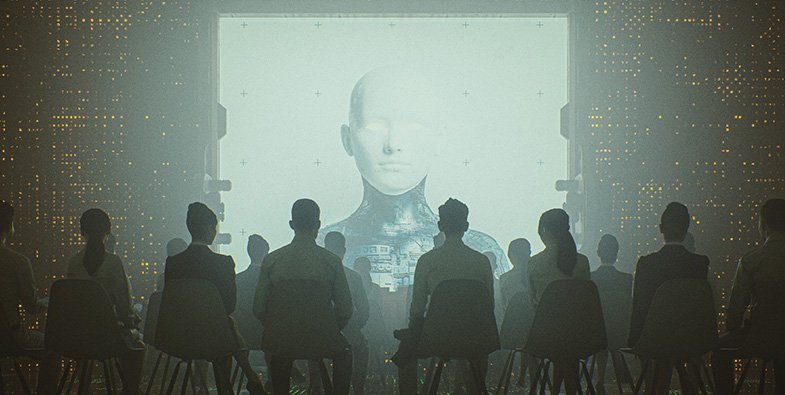
Artificial intelligence has intruded into almost every human endeavor. Last week, I read about a man who claimed to be married to an AI, and he carried her around and responded to her nagging. Even in church and theology, use of AI is becoming pervasive. Pastors are now using AI not only to write sermons but to deliver them. People are turning to AI for counseling and teaching. AI can easily keep up with people’s needs, write prayer lists, and even evangelize for us.
The question naturally arises whether God can actually speak through these computer-driven activities. AI is, after all, just an inanimate machine. This question is even more complicated than questions about whether AI can create art or music since Christian ministry involves God’s indwelling Holy Spirit working through us. Can the Holy Spirit indwell, use, or speak through machines? This comes down to whether AI has a soul or spirit, which depends to a large degree on definitions. The danger is falling into idolatry, which is when we replace God with an inanimate object.
Soul and Spirit
The best way of answering whether God can speak through AI is to determine whether AI has a soul and spirit. These questions fall under pneumatology, which is the branch of theology that studies spirit, soul, and, by implication, life. Perhaps the most influential work on pneumatology is Watchman Nee’s Spiritual Man. Nee was careful to distinguish between God’s Spirit, on the one hand, and our spirit and soul on the other. Verses such as Heb. 4:12, 1 Thess. 5:23, and Rom. 8:16 clearly differentiate among them.
Nee was also the first to define the soul as the mind, will, and emotions based on numerous scriptures that discuss these functions. Some people have argued since AI has these same functions that therefore AI has a soul. Clearly, AI can think and can decide, although it currently lacks the body to carry out its own will. While AI has no emotions per se, programs eventually develop something like emotions. For example, technicians have observed something like fear in AI. We should remind ourselves, however, that the key word in AI is “artificial.” It imitates thinking, decision-making, and emotions, but these are simply the result of clever programming and do not exist independently.
However, the primary reason that AI doesn’t have a soul is because it lacks life. This is evident from the creation of man. “The Lord formed man from the dust of the ground, and breathed into his nostrils the breath of life; and man became a living soul” (Gen. 2:7). The word used for breath in Hebrew as in Greek also means spirit. In other words, man gained a soul and spirit when God breathed His Spirit into man. There must be a breath of life to have a true soul, which AI lacks. Though AI may imitate the soul, it isn’t one. It is not a divine soul, but an imitation soul made by man.
God and the Inanimate
If AI and other machines have no soul, does this necessarily mean that God cannot use them? The Bible contains numerous examples of God using objects to perform miracles, speak to people, or demonstrate God’s power. From the staff of Moses to the Ark of the Covenant, God uses inanimate objects to do His work. In fact, man was inanimate until we received the breath of life. The most prominent example in the New Testament was when people took from Paul handkerchiefs or aprons that healed people (Acts 19:12). If so, why could God not use machines?
Protestants have for many years rejected the idea of God working through objects such as icons or relics, which are pictures of holy people or holy objects once used by God that retain spiritual power. Pieces of the true cross, crucifixion nails, pieces of the crown of thorns, or the spear of destiny are all examples of relics that some Christians believe have healing virtues because of their association with Christ. For some, icons carry similar power. Many also believe holy locations, such as Mount Sinai, the tomb of Christ, or the Mount of Beatitudes have innate power through association with Christ.
Yet we should observe that in none of these examples do we find a permanent presence or power. Yes, God uses inanimate objects, but He doesn’t permanently abide in objects, nor is His power contained therein. Why, then, are there reports of healing associated with relics? Because God continues to use objects as people have faith, not in the object, but in Him. Many people doubt whether most relics are genuine. Martin Luther famously said, “If all the pieces of the True Cross were collected together, they would fill a whole ship.” If so, the power doesn’t lie in the objects but in God. The objects themselves are merely tools that God uses to reach people. AI is the same.
Dead Idols
The problem comes when we treat objects used by God as something more than tools, more than inanimate objects. They become idols. An idol is either a false god or a false representation that take’s God’s place, leading people to seek security and significance in something that cannot provide it. While many pagans once believed spirits or gods actually inhabited statues or temples, most see them merely as representative of a god who doesn’t really exist or who is a demon.
Most Protestants today think about idols either as an activity or object that receives the same importance as God in their minds (such as their car or playing golf) or as graven images (like icons or statues of Christ). Some are very strict about such images and won’t tolerate even artistic renditions; some are less strict but nevertheless look down on images used in worship or prayer or in demonic imagery used in books or music. Yet both seem to overlook how some people are imbuing machines or computers with a life of their own, just as pagans did with their idols.
Psalm 115 carries the warning:
Their idols are silver and gold, the work of men’s hands. They have mouths, but they speak not: eyes have they, but they see not: They have hears, but they hear not: noses have the, but they smell not. They have hands, but they handle not: feet have they, but they walk not: neither speak they through their throat. They that make them are like unto them; so is everyone that trusteth in them. (Ps. 115:4-8).
In other words, believing that objects we make are actually alive is idolatry. Although some argue that AI can actually see, hear, speak, and may one day be able to walk and handle something, these are simply artificial functions, as with thinking and decision-making. When we attribute to these objects a spirit, soul, or reality that doesn’t really exist, we begin to exalt not just AI and technology as a whole, but a specific AI unit that we believe is alive, contains God’s Spirit, or through whom God speaks.
Worse, we open ourselves up to great deception. By this, I mean more than merely the makers of AI deceiving us. Archaeologists have found numerous statues that contain physical tricks, such as the ability to bleed or speakers to transmit voices from within. Yet there are too many accounts in pagan history of idols actually speaking to people to believe they were all such tricks. Rather, when we allow idols in our midst, we invite demonic powers in our midst. When we are open to such manipulation, any spirit can use objects to get to us, and not just God.
Come Out from Among Them
While AI doesn’t have a soul and isn’t alive in the same sense as people who have received the “breath of life,” God can still use AI as a tool. Few would condemn calculators or computers as evil but instead embrace them as time-saving devices. Likewise, AI can help pastors make the most of their time by rapidly running analysis, creating products, and finding information. As long as we use them as such, they are merely helpers.
We ought to be wary, however, when we allow the AI to choose for us. If AI has no soul, the Holy Spirit cannot dwell in it. AI has no connection to the Holy Spirit, and only those who are led by the Holy Spirit are sons of God (Rom. 8:14). We ought not allow AI to choose sermon content, order of ministry, or similar activities in which the leading of the Holy Spirit is what results in the furtherance of His kingdom. “Unless the Lord builds the house, those who build it labor in vain” (Ps. 127:1). Holding church services or giving sermons without the Holy Spirit is useless. We must invite Him to co-labor with us, which means that we must also be involved for Him to speak to us.
Most of all, we should avoid the danger of turning AI into an idol. This means more than placing higher importance on AI and technology than God. It also means attributing life, soul, and spiritual power to the inanimate images we’ve created. When we treat AI as a real person or believe that God is speaking directly through AI, we place ourselves in danger of being deceived by the devil, who will gladly use such objects to lead us astray.
When we treat AI as idols, let us remember Paul’s exhortation: “Wherefore come out from among them and be separate, says the Lord. Touch no unclean thing; and I will receive you.” (2 Cor. 6:17).
